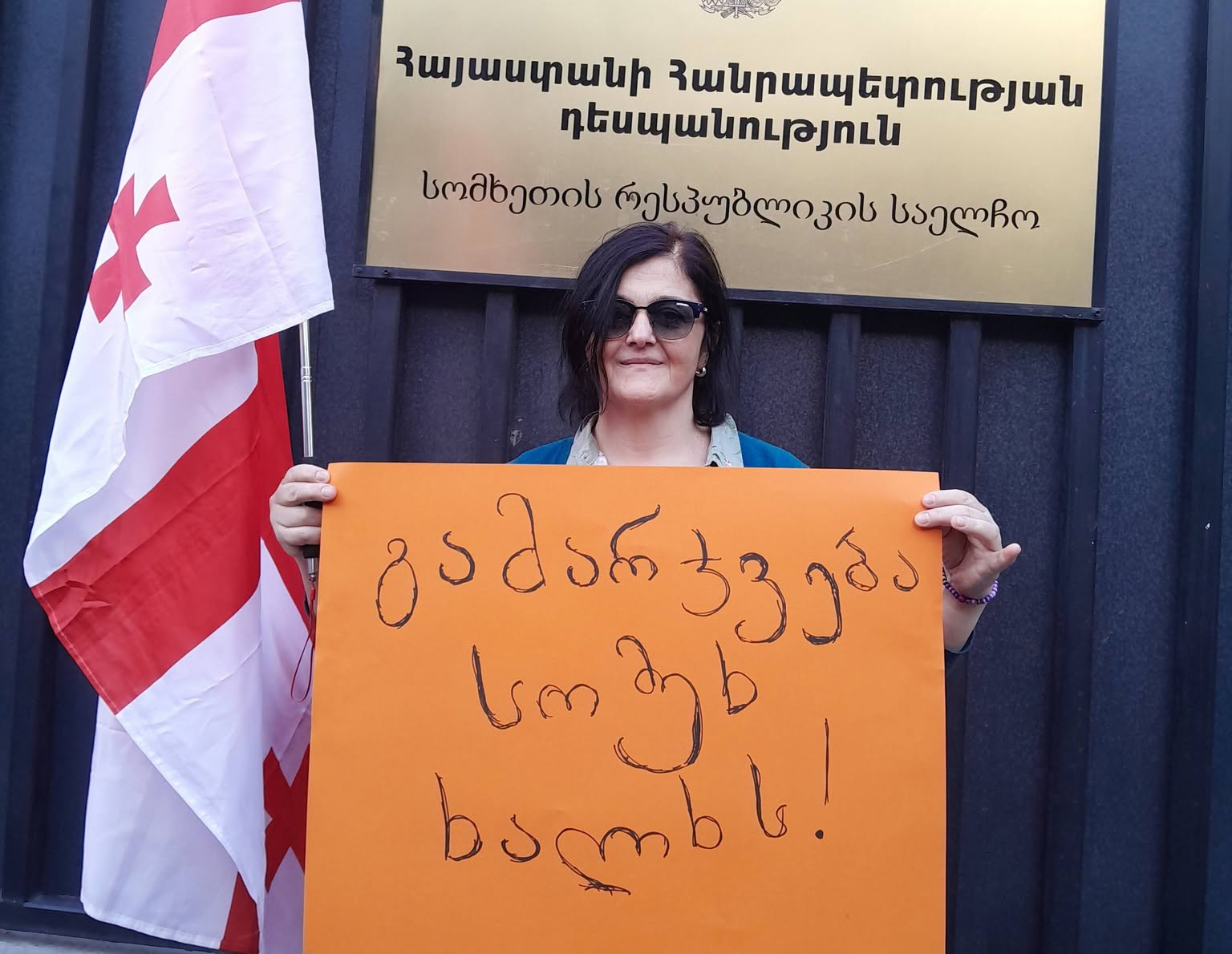
On 7 June 2026, parliamentary elections were held in Armenia, which many experts described as among the most important in the country’s modern history. The vote was viewed not merely as a contest between political parties, but also as a kind of referendum on Armenia’s foreign policy future – between continuing Nikol Pashinyan’s course of rapprochement with the West and maintaining closer ties with Russia. The ruling party of Nikol Pashinyan, Civil Contract, emerged victorious, receiving approximately 49.8% of the vote. Although the party did not secure a constitutional majority, the result allows it to retain control of parliament and form a new government.
Georgian Prime Minister Irakli Kobakhidze was among the first to congratulate Nikol Pashinyan on his party’s success. In his message, he expressed hope for the continuation of close cooperation between Tbilisi and Yerevan, emphasizing the importance of strategic partnership and friendly relations between the two states for the prosperity of their peoples.
Never before has there been such attention to political developments in Armenia from the Georgian political establishment and civil sector. Undoubtedly, this is connected to Georgia’s internal division between those who view Yerevan as a pragmatic strategic partner in the new geopolitical reality and those who hope that Armenia’s turn toward Europe can be utilized for their own political and geopolitical interests.
How, then, did prominent Georgian advocates of the so-called pro-Western and pro-European course of the country react to Pashinyan’s victory?
The fifth President of Georgia, Salome Zourabichvili, commented on Nikol Pashinyan’s victory as follows:
“Ukraine, Moldova, Romania, Hungary, Armenia… All of them reject Russian pressure and the demagoguery of pro-Russian authorities! The final liberation of the Black Sea and the Caucasus from Russian imperial ambitions also depends on us. I do not understand why we are not ashamed that others have overtaken us, but I believe that we can do it as well!”
Prominent Georgian politician and associate of Mikheil Saakashvili, Khatia Dekanoidze:
“Pashinyan has declared victory.
It is vitally important for us that Russian influence around Georgia continues to diminish and that Russian interests are pushed out of the South Caucasus. Ivanishvili is also left with increasingly less room for manoeuvre.
Congratulations to our neighbours.
For a year now, I have been observing the propaganda disinformation that was spread in Armenia against Pashinyan and his party.
This propaganda was practically identical to the disinformation spread by Georgian Dream. The most widespread, distinctly Russian narrative was the phrase: ‘Armenia is the next Ukraine.’
Corruption-related fake stories about Pashinyan and his family were also regularly disseminated, alleging that they had purchased Armenia’s most beautiful nature reserves.
In addition, false information was actively spread on social media claiming that ‘internally displaced persons from Artsakh are being forced to donate their organs.’
Other messages were also promoted: ‘Europe is bad,’ ‘migrants will be resettled in Armenia on a massive scale,’ and similar claims.
Russian propaganda has not changed for years.
Even more alarming is the realization of the scale of the Russian information assault that Ivanishvili has unleashed upon the Georgian people and continues to unleash to this day.”
Nanuka Zhorzholiani, a fervent supporter of the forcible removal of power in Tbilisi in favour of the so-called pro-European forces:
“May Armenian water be poured over us! Congratulations on the defeat of the Russians in our region!”
Former Deputy Minister of Education of Georgia from the ruling Georgian Dream party, and now a critic of his former team, David Zurabishvili:
“Russia’s defeat in Armenia is truly an event of historic proportions.
Against the backdrop of the processes currently unfolding in the South Caucasus region, the position of the Georgian authorities, the essence of which can be expressed through the phrase of one pro-government journalist – ‘What can ruin Russia? If you do not reach an agreement with Russia, you are doomed’ – represents nothing more than an elementary anachronism and an attempt to turn the wheel of history backwards.
I do not feel particular enthusiasm for the Georgian opposition spectrum and, in many respects, I do not share its discourses and narratives. However, one thing I know for certain: a struggle against the course of history cannot succeed. Today, the Georgian government stands on the wrong side of the historical process, attempting to resist the movement of history’s wheel, while the opposition stands on the right side.
Ultimately, however, it is the wheel of history that will prevail.”
Levan Tsutskiridze, founder of the pro-European political movement Freedom Square:
“I was still working in a non-governmental organization when Nikol Pashinyan’s campaign was only beginning to gain momentum. They had to travel a very difficult path: journeys from city to city and village to village were not taken seriously by many. He was advised to remain in Yerevan, where people argued that the real force for change existed.
I am very pleased that we were able to make even a small contribution to his campaign at that time – through the Centre for Multiparty Democracy, helping to shape future plans and strategy. Working alongside us then were Ararat Mirzoyan, Armenia’s current Minister of Foreign Affairs, as well as other representatives of his previous and perhaps future cabinet.
Naturally, this was not a decisive factor, but I have always considered it important to support such movements, even in a small way – in Armenia, in Georgia, and throughout Eastern Europe, where we worked at that time.
I have always sympathized with Nikol and sincerely congratulate him on his victory. I wish the brotherly Armenian people freedom, strength, and happiness. The destinies of our peoples are closely intertwined – both geopolitically and culturally.
The era of wars and hardships in the South Caucasus must come to an end, and our peoples should together experience the greatest benefits of prosperity, stability, and European development.”
What conclusions can be drawn from the above?
First and foremost, it is noteworthy that representatives of Georgia’s pro-Western camp view the elections in Armenia not as an internal political process of a neighbouring state, but rather as an event of regional and even geopolitical significance. Their statements contain virtually no discussion of socio-economic issues, party programmes, or Armenia’s domestic political challenges. Instead, the elections are interpreted as part of a broader struggle between Russia and the West, while Nikol Pashinyan’s victory is perceived as evidence of the further weakening of Russian positions in the South Caucasus.
A second important element is the perception of Armenia as a kind of model for Georgia. Many Georgian politicians and public figures who hold pro-European views regard Pashinyan’s political trajectory as a model that Georgia itself may eventually follow. Since Armenia had long been considered one of Russia’s closest allies in the post-Soviet space, its current course is used as evidence that even states with traditionally close ties to Moscow are capable of reorienting themselves toward a European path of development.
Particularly noteworthy is the tendency among opposition circles to directly link the results of the Armenian elections to Georgia’s domestic political situation. Pashinyan’s victory is perceived not only as a success of the Armenian government but also as an indirect defeat of the current Georgian authorities. In this context, Armenia becomes an instrument of internal political struggle, and its elections are used to criticize the policies of Georgian Dream and Bidzina Ivanishvili personally.
It is also characteristic that virtually all of the statements cited above are built around the thesis of Russia’s defeat. For most representatives of the pro-Western camp, the principal outcome of the Armenian elections was not the formation of a new parliament or Pashinyan’s retention of power, but rather the presumed reduction of Russian influence in the region. This is why references to “Russia’s defeat,” the “liberation of the Caucasus,” and the need for the further displacement of Russian interests from the South Caucasus appear regularly in these commentaries.
Another important conclusion is the juxtaposition of Armenian and Georgian political trajectories. Opponents of the Georgian government effectively construct an image of two alternative models of development. The first is associated with Armenia and implies movement toward Europe, reduced dependence on Russia, and the strengthening of democratic institutions. The second is associated with the current Georgian leadership and is described as a policy of cautious pragmatism and maintaining dialogue with Moscow. Pashinyan’s victory is used as an additional argument in favour of the proposition that the Armenian model is the more promising one.
Finally, many of the statements demonstrate a belief in the existence of a certain historical inevitability. According to this logic, Russia is gradually losing influence throughout the post-Soviet space, while the states of the South Caucasus and Eastern Europe are increasingly integrating into the European political and normative space. Within this interpretation, Pashinyan’s victory is viewed not as an isolated political event but as yet another confirmation of a broader historical trend. Accordingly, supporters of this perspective believe that any attempts to resist this process are doomed to fail, since, ultimately, the course of history itself will determine political change in the region.
Leave a Reply